
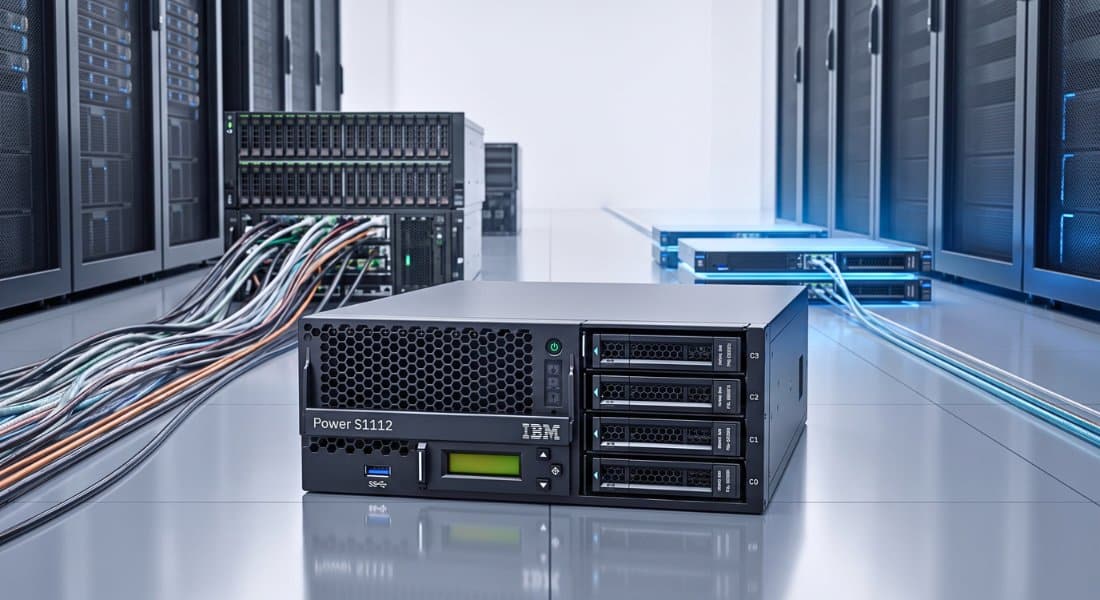
The Power11 S1112 is here, and the spec sheet is genuinely impressive. A single active processing core delivers a rating of 29,000 CPW. You get 800 gigabytes of baseline storage and 64 gigabytes of memory built in before you make a right-sizing decision. For shops running older Power8 or Power9 iron, those numbers sound like a meaningful leap forward.
While that leap is real for aging environments, most IBM i shops won't need that kind of upgrade. The right move is to assess whether your shop needs that jump and whether the price tag makes financial sense for your company.
The Power11 S1112 ships with specifications that far exceed what most mid-market IBM i environments consume. For shops running 2,000 to 6,000 CPW workloads, jumping to the Power11 S1112 means paying for idle capacity. Right-sized cloud LPARs offer a financially sharper alternative that you should model before committing to new iron.
The Real Impact of the Power11 S1112 on Your Workload
Commercial Processing Workload, or CPW, is IBM's standard benchmark for measuring system speed on IBM i platforms. To put the S1112's 29,000 CPW rating in context, consider where most mid-market IBM i environments actually operate.
While a Power8 or Power9 server carries a high published rating, most mid-market shops only consume 2,000 to 6,000 CPW during daily operations. In legacy setups, small drive counts created bottlenecks long before the CPU hit its ceiling. Upgrading to a 29,000 CPW baseline on Power11 means paying for massive processing headroom that your daily operations will never touch.
Jumping to 29,000 CPW gives small shops ten times the processing capacity they actually consume. Query jobs that once took five minutes now return in under a second. That speed sounds impressive, but it rarely changes day-to-day operations. You end up paying a premium for extreme performance that typically won't deliver a meaningful difference.
Baseline Storage and Memory vs. Real Operational Needs
Higher processing speeds address only one part of your overall operational needs. The S1112 ships with 800 gigabytes of baseline storage and requires 64 gigabytes of memory as a starting point.
A large portion of mid-market IBM i clients run comfortably on 150 to 400 gigabytes of storage. They also use just 8 to 16 gigabytes of memory for legacy software workloads. Independent software vendor (ISV) software environments need more, often 32 to 64 gigabytes of memory. Yet even those shops reach the S1112 baseline out of necessity, not design.
Evaluating these hardware specifications reveals a straightforward economic reality for IT managers. You pay for capacity on day one that your environment may not need for several years.
Keep a key technical detail in mind for continuous operations. The S1112 ships without hot-swappable PCI adapters, unlike prior Power generations and larger Power11 systems. PCI cards in this entry model require a full system shutdown for replacement. Single-shift or two-shift operations easily accommodate PCI card replacements during standard maintenance windows. However, 24/7 operations must factor this forced downtime into their hardware planning.
IBM i Subscription Licensing Shifts the Five-Year Budget Model
Understanding the full financial commitment requires looking beyond base hardware specifications to evaluate multi-year operating costs. The S1112 uses IBM's current software subscription licensing model instead of the old perpetual license structure. IBM i subscription licensing requires ongoing payments over a set term, usually five years, and coverage ends when payments stop.
This represents a significant shift in how mid-market teams must budget long-term. The IBM Software Maintenance Agreement (SWMA) terms reinforce this by requiring active coverage for fixes and security patches.
Pricing for the S1112 lands in the $40,000 to $60,000 range, higher than Power10 entry systems, which cost roughly $18,000 to $30,000. Add hardware support and multi-year software subscriptions, and your five-year total cost of ownership can start to look less attractive.
Some organizations pay $100,000 or more annually for IBM i software support. For those shops, a Power11 investment fits into an existing budget framework. For cost-conscious mid-market operations, evaluating total hardware and subscription expenses often makes right-sized cloud alternatives appealing.
Power10 entry pricing has also risen during the Power11 cycle. New hardware costs more now than two years ago, regardless of the generation you choose. We take a closer look in our post on how the end of perpetual licensing affected IBM i total cost of ownership.
The Financial Case for Cloud LPARs Through IBM i Right-Sizing
This makes Cloud400 hosted logical partitions a compelling financial option, not just a preference.
A hosted LPAR matches your actual usage, providing 4,000 to 6,000 CPW, 150 to 200 gigabytes of storage, and custom memory allocations. You do not buy 29,000 CPW when your environment uses 3,000. You do not pay for 800 gigabytes of storage when your data footprint stops at 175.
| Power11 S1112 baseline | Typical mid-market IBM i shop | Right sized Cloud400 LPAR | |
|---|---|---|---|
| Processing | 29,000 CPW from a single core | 2,000 to 6,000 CPW | 4,000 to 6,000 CPW |
| Storage | 800 GB baseline | 150 to 400 GB | 150 to 200 GB |
| Memory | 64 GB required as a starting point | 8 to 16 GB for legacy software, often 32 to 64 GB for ISV environments | Custom allocation |
| Hardware price | $40,000 to $60,000 (Power10 entry systems ran roughly $18,000 to $30,000) | Not applicable | No hardware purchase, predictable monthly cost |
| Software licensing | Subscription, coverage ends when payments stop | Not applicable | No subscription tied to owned hardware |
The financial advantage becomes clear when you look at what disappears. You eliminate capital expenditures on hardware, ongoing maintenance contracts, and software subscriptions tied to owned iron. The OPEX model replaces heavy capital spending with predictable monthly costs. IBM i right-sizing ensures those monthly costs match actual usage rather than manufacturing economics.
IBM's hardware economics favor larger systems because big units cost less per unit to produce. IBM has little financial incentive to build a smaller, cheaper server designed specifically for mid-market usage. Cloud LPARs, by contrast, are sized around your workload rather than assembly-line efficiencies.
Bob Losey has worked with IBM midrange systems since 1979. The gap between what IBM ships and what mid-market clients consume is a pattern that predates the AS/400 name.
"If you go to 29,000 CPW, in my opinion you're getting an oversized computer. Most of these smaller users can get their work done with 8 to 16 gigabytes of memory if it's legacy software. The way the system is now introduced, the operating system compels you to use 64 gigs of memory. You're coming right out of the gate with more capacity than you need. If you go to the cloud, we can size your LPAR to be just what you need, not 29,000 CPW, but maybe about 4,000 to 6,000 CPW. And so it makes hosting a very attractive financial proposition when you compare it to the cost of owning an on-premise server." – Bob Losey, Founder and President, Source Data Products
Power11 Hardware Still Makes Sense for Some Shops
Moving to a cloud environment may not be the ideal solution for every organization. Power11 hardware remains the right choice for organizations with strict data locality rules or regulatory mandates that prevent third-party hosting. It also suits ISV software environments that consume the full capacity of the S1112.
Cloud hosting depends on a stable, redundant internet connection for consistent performance and reliability. Shops with poor or single-circuit connectivity should address those limitations before migrating. Without adequate network infrastructure, on-premises hardware remains the more practical option regardless of cost comparisons.
Making the right hardware choice requires a direct side-by-side comparison of your options. The S1112 is a solid system if your workload requires a single core rated at 29,000 CPW and needs owned hardware. If your workload runs well at 4,000 CPW, a hosted LPAR deserves a close look to avoid paying for unused capacity.
Common Questions About Power11 and IBM i Right-Sizing
What is CPW and why does it matter when evaluating IBM i hardware?
CPW stands for Commercial Processing Workload, which is IBM's standard benchmark for system speed on IBM i platforms. It gives IT leaders a clear way to compare processing power across hardware generations. The key is matching CPW to your actual workload, not buying headroom you will not use. For a broader look at hardware options, visit Source Data's IBM i on Power Server resource.
How much CPW do most mid-market IBM i environments actually consume?
Most mid-market IBM i shops run between 2,000 and 6,000 CPW under normal operating conditions. This range reflects typical storage device counts and legacy software workloads. Organizations in this range evaluating Power11 hardware are looking at ten times the capacity their daily operations require.
What changed with IBM i software licensing on Power11?
Power11 systems use IBM's subscription licensing model instead of the traditional perpetual license structure. Subscription licensing ties software coverage to ongoing payments over a defined term, typically five years. Your active software license coverage ends the moment these recurring payments stop.
What does IBM i right-sizing mean in the context of cloud hosting?
Right-sizing means provisioning a hosted logical partition with the exact CPW, storage, and memory your workload uses rather than paying for unnecessary hardware capacity. A right-sized LPAR for a mid-market shop might run 4,000 to 6,000 CPW and 150 to 200 GB of storage. That compares to the S1112 baseline, where a single core alone delivers about 29,000 CPW and systems default to 800 GB or more of storage. The cost difference between these options is substantial over a five-year lifecycle.
How does the Power11 pricing compare to what Power10 cost?
The Power11 S1112 costs between $40,000 and $60,000 for hardware alone. Previous entry-level Power10 configurations typically cost organizations between $18,000 and $30,000. That shift makes buying new iron more expensive than it was two years ago. Adding software subscriptions and support pushes the five-year total cost of ownership well beyond the base hardware price.
Can an IBM i shop run a Cloud400 LPAR during a 60-day validation before committing?
Yes, Source Data offers the 60-Day Cloud400 Validation for Cloud400 hosting. This lets IBM i teams test workloads in a right-sized environment before making a long-term commitment. This gives IT directors and CIOs a concrete performance and cost baseline to set against any hardware quote. Learn more about the 60-Day Cloud400 Validation.
What are the main reasons IBM i shops stay on-premises rather than moving to cloud hosting?
The most common reasons include strict data locality rules, regulatory mandates limiting third-party hosting, ISV applications that require dedicated hardware, and weak internet connections. Organizations facing these constraints should address them before exploring cloud options. For shops without those limitations, the financial case for right-sized cloud LPARs grows stronger as hardware costs rise.
Making the Right Decision for Your Environment
If your Power8 or Power9 system is reaching end of support, the arrival of the S1112 changes your refresh options. Power10 entry pricing has moved up during the Power11 launch, making five-year cost calculations more demanding than they were two years ago.
This shift makes it the right time to compare a right-sized cloud LPAR directly against your hardware quote. The right choice depends on your workload profile, connection stability, licensing setup, and preference for capital versus operational spending. Comparing the numbers gives you a clear path forward before you sign a purchase order.
Source Data gives IBM i shops a practical way to compare cloud hosting with new hardware. Contact our team to compare your five-year costs before choosing new hardware.
ABOUT THE AUTHOR
Bob Losey | Founder & President, Source Data Products | 45+ years in IBM midrange systems since 1979 | 4,000+ clients served | Premier IBM Business Partner | Developer of Cloud400 hosting platform | IBM i Technical Certifications (2000-2020) |

