
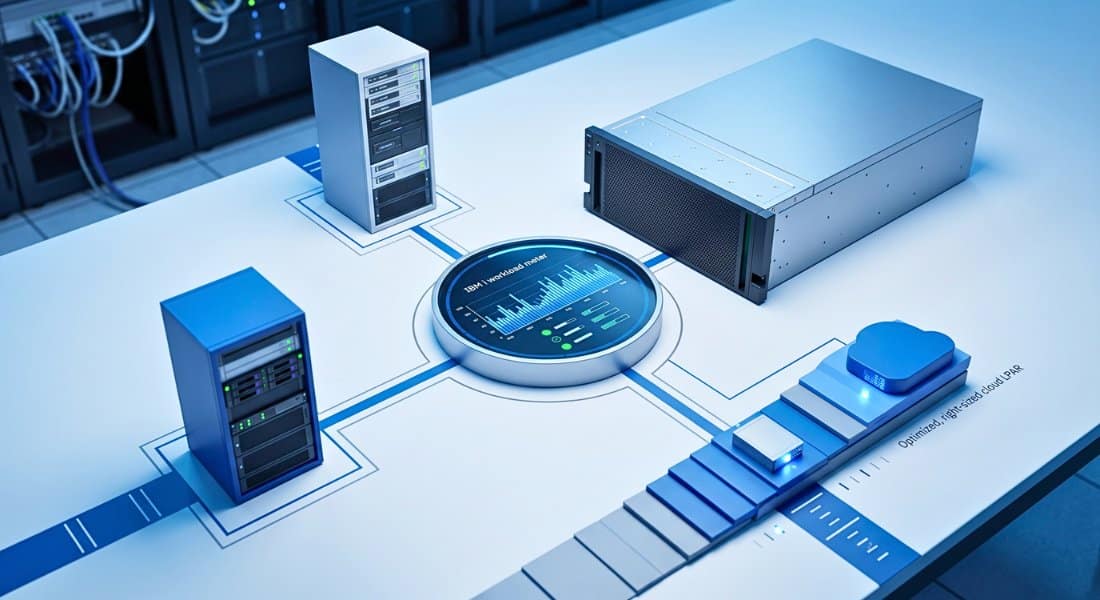
Running IBM i on aging Power9 hardware puts many mid-market teams at another infrastructure decision point. Power11 has arrived, pricing has changed, and the idea of moving to the latest hardware can feel compelling. But most mid-market IBM i shops never consume the full capacity the new hardware offers.
Understanding the IBM i hardware upgrade landscape before signing a quote can prevent years of paying for more capacity than the workload requires.
Power11 entry-level server costs around $40,000 to $50,000 for just the server. Depending on hardware, software, support, and services, you could be looking at $25,000 to $50,000 all in. Three practical paths deserve consideration: right-sized hosted IBM i, or Power11 for organizations committed to on-premises IBM i. The right answer depends on workload, staffing, licensing, and long-term platform plans.
Power11 Costs for Mid-Market IBM i Buyers
The Power S1112 brings Power11 technology into the entry-level P05 software tier for IBM i customers. For IBM i LPARs on the S1112, it supports up to four cores and 64 GB of memory across its IBM i logical partitions. This entry-level configuration provides far more processing capacity than many smaller environments require for their daily workload.
Source Data often sees mid-market IBM i workloads operating around 2,000 to 6,000 CPW of actual demand. That difference matters because hardware capacity and actual workload demand don’t always match closely. Current entry-level Power11 quotes can reach roughly $65,000 to $100,000 after you add configuration, software, support, and related services. The final number depends on the exact system design, so no single Power11 price applies to every buyer.
Power11 also begins with substantial memory and modern NVMe storage capacity compared with many older mid-market IBM i environments. That additional capacity can help with growth, consolidation, or other workloads running alongside IBM i.
For a smaller IBM i environment, however, the better question is whether the organization will regularly use the capacity it purchases.
IBM i Subscription Licensing Changes the Cost Comparison
A second cost layer comes from IBM’s continued move toward subscription licensing for IBM i. New IBM i licenses for Power11 generally use subscription terms rather than the traditional non-expiring perpetual licensing model. That means the subscription must remain current for continued licensed use after the selected term ends.
Existing perpetual IBM i entitlements still exist in supported legacy environments, so the licensing change does not affect every IBM i customer the same way. Third-party application licensing can add another significant cost depending on the ERP, user count, processor tier, and vendor agreement.
One Source Data client pays approximately $100,000 annually for their manufacturing software support from a major ERP vendor running on IBM i. For that organization, new Power hardware can still make sense because IBM i remains central to daily operations and long-term technology plans.
For smaller operations, review hardware, IBM licensing, application fees, support, staffing, and maintenance together. That combined cost can look very different from the hardware price shown on the initial quote. A hosted LPAR through Cloud400 can instead be sized around the workload the customer actually requires.
Instead of buying a full physical server for a smaller workload, Cloud400 can allocate processing, memory, and storage to match actual operating needs. The financial comparison changes when the organization pays for a right-sized hosted environment instead of owning the entire physical platform.
Power9 Decisions in 2026
Several widely used Power9 models reached the end of IBM standard service at the end of January 2026. Other Power9 models follow different lifecycle dates, making the exact machine type and model important before planning the next step.
Systems leaving standard service may still have support options, but coverage, parts availability, and service arrangements may differ from active IBM maintenance.
The point is not that every Power9 system should leave the data center immediately. A better approach is to understand the exact support arrangement before deciding whether extended maintenance provides enough coverage.
The larger question is whether owning another physical server still fits the organization's software costs, staffing, support needs, and plans.
We have also identified a specific concern involving system-board replacement under certain extended hardware support arrangements. Our post about the hidden risk in extended hardware support covers some of the issues we've seen.
Choosing Between Hosting, Bridging, and New Hardware
Bob Losey founded Source Data Products in 1979 and has spent decades helping IBM i shops evaluate changing hardware generations. Source Data also provides both IBM Power server solutions and Cloud400 hosting, so the recommendation does not depend on selling one approach.
"If you go to the cloud, we're going to host you in that environment. You will not have anything as high as the cost of the software service. Plus, we can size your LPAR to be just what you need. Not 29,000 CPW, but maybe about 4,000 to 6,000 CPW. It makes hosting a very attractive financial proposition when you compare it to owning an on-premise server." – Bob Losey, Founder and President, Source Data Products
A hardware decision should start with what your workload requires. You need to balance application reliability with IBM i versions, support, security planning, staffing, and long-term costs.
Two IBM i Hardware Upgrade Paths to Consider
1. Right-Sized Hosted LPAR
This approach moves IBM i infrastructure from a capital purchase into a predictable hosting expense. Cloud400 sizes the hosted LPAR around the processing, memory, storage, and operating requirements of the actual environment. The organization also avoids owning another physical server and managing the related hardware lifecycle internally.
This path fits companies prioritizing cost predictability, continuity, and access to IBM i expertise beyond their internal staff. Our 60-Day Cloud400 Validation lets organizations test their own workload without making a long-term financial commitment.
2. Power11 Adoption
Power11 makes sense for organizations that expect IBM i to remain a central business platform for many years. It also suits teams that want current hardware, a long planning horizon, and enough workload to justify the available capacity.
The Power S1112 now gives P05 IBM i customers a Power11 option with up to four IBM i cores per LPAR. Organizations requiring more capacity can evaluate other Power11 models based on their workload and IBM i software tier. Our IBM i on Power Server page explains Source Data's approach to IBM Power sizing, migration, and support.
The right path depends on workload, staffing, software vendors, support expectations, and plans for IBM i over the next several years.
A complete cost comparison is more useful than choosing from the hardware quote alone.
FAQs About IBM i Hardware Upgrade Paths
How do IBM i software licensing costs change on Power11?
New IBM i licensing on Power11 requires subscription terms rather than traditional non-expiring licenses. Third-party application vendors may also base their charges on processors, users, hardware changes, or software tiers. We covered this in a recent post exploring how total cost of ownership changed with the end of perpetual licensing.
What does IBM i right-sizing mean in a cloud hosting context?
Right-sizing means matching hosted processing, memory, and storage resources to the workload the IBM i environment actually uses. Source Data often finds that smaller mid-market IBM i workloads use considerably less processing capacity than new physical servers provide. A right-sized LPAR reduces unused physical capacity and lowers the customer's infrastructure costs.
Can I run multiple LPARs on a Cloud400 hosted environment?
Yes, Cloud400 supports multiple LPAR configurations for organizations requiring separate production, testing, development, or other IBM i environments. You can size each LPAR to match the workload and operating requirements for that environment.
What should I verify before accepting a Power11 hardware quote?
Start by comparing the proposed processing capacity with the workload your IBM i environment actually uses. Then review memory, storage, IBM i subscription costs, application licensing, hardware support, migration services, and the expected ownership period. Those numbers provide a more complete comparison than the physical server price by itself.
What connectivity requirements exist for hosted IBM i environments?
Hosted IBM i requires reliable business-grade connectivity between users, locations, integrations, and the hosted environment. Organizations should review their existing internet service, redundancy needs, remote locations, and application traffic before migrating. Companies with reliable connectivity can address these requirements during the hosting assessment and migration planning process.
How does IBM i right-sizing affect disaster recovery planning?
A right-sized production environment also provides a clearer baseline for determining the resources needed at the disaster recovery target. The recovery design should still reflect required RTO, RPO, application performance, replication method, and expected workload during recovery.
What is the practical difference between active IBM maintenance and extended hardware maintenance?
Active IBM maintenance provides standard IBM hardware support while the applicable system remains within its standard service period. After that period ends, available extended support arrangements can differ by machine, contract, provider, parts availability, and service level. Source Data recommends reviewing those details before assuming extended coverage provides the same support as active IBM maintenance.
Match the Hardware Decision to the Workload
Power11 is a capable platform and a strong choice for organizations planning a long-term future around IBM i. For many mid-market shops, the more useful starting point is determining the processing, memory, storage, staffing, and support they actually need. That review may support a Power11 purchase, or a right-sized Cloud400 environment.
Source Data Products has helped IBM i customers make these infrastructure decisions since 1979. Let our team review your IBM i workload and help match it to the right infrastructure path.
ABOUT THE AUTHOR
Bob Losey | Founder & President, Source Data Products | 45+ years in IBM midrange systems since 1979 | 4,000+ clients served | Premier IBM Business Partner | Developer of Cloud400 hosting platform | IBM i Technical Certifications (2000-2020) |

